Finding the right titanium pool heat exchanger for saltwater, chlorine-heavy environments, or spa and hot tub setups can optimize efficiency, durability, and maintenance costs. This guide highlights five top titanium models, emphasizing corrosion resistance, heat capacity, and installation versatility. Each product is evaluated by design, compatibility, and key features to help you compare options quickly and confidently.
| Product | Brand | Capacity (kBtu/hr) | Ports | Notes |
|---|---|---|---|---|
| AB Full Titanium Pool Heat Exchanger 360k | AB | 360 | 2″ & 1 1/2″ FPT | |
| AB 55kBtu Titanium Full Exchanger For Spa | AB | 55 | 1″ & 3/4″ FPT | |
| AB Swimming Pool Heat Exchanger 55kBtu Titanium | AB | 55 | 1 1/2″ & 1″ | |
| AB 600kBtu Titanium Pool Heat Exchanger | AB | 600 | 2 1/2″ & 2″ FPT | |
| SP 2.0 Series 300,000 BTU Titanium | Outdoor Furnace Supply | 300 | Brackets included |
AB Full Titanium Pool Heat Exchanger 360k Btu

Capacity and design: This titanium heat exchanger handles up to 29,000 gallons with 360 kBtu/hr based on a 60°C temperature difference between incoming heating and heated water. It uses fully titanium construction, offering long life and strong anti-corrosion properties to withstand saltwater and chemical exposure. The unit features 2″ FPT for pool water and 1 1/2″ FPT for hot water.
Key benefits: Titanium’s corrosion resistance reduces maintenance needs and offers a longer service life compared with stainless steel in harsh pool environments. The all-titanium build supports sustained performance in saltwater pools and heated spa connections while providing solid thermal transfer.
AB 55kBtu Titanium Exchanger For Spa
Capacity and design: This model provides 55 kBtu/hr of heating for saltwater applications up to about 4,000 gallons. It uses 99.99% pure titanium and titanium-filled welding material, delivering enhanced durability and reliability. Ports are 1″ FPT for pool water and 3/4″ FPT for hot water, with a total wattage around 16KW.
Key benefits: Titanium’s longevity and corrosion resistance help minimize repairs in spa and hot tub environments, especially when paired with chemical treatments. Its compact form factor is ideal for tight installations or retrofits in small pools and spas.
AB Swimming Pool Heat Exchanger 55kBtu Titanium

Capacity and design: This unit supports up to 4,000 gallons with 55 kBtu/hr, designed for saltwater or chemically treated pools. It uses fully titanium construction and features 1 1/2″ FPT for pool water and 1″ FPT for hot water, with a 16KW rating. The titanium approach aims to extend product life in aggressive pool environments.
Key benefits: Anti-corrosion performance reduces long-term maintenance costs. The unit’s compatibility with marine engines also broadens its application to engine cooling and other high-chlorine scenarios.
AB 600kBtu Titanium Pool Heat Exchanger
Capacity and design: This high-capacity titanium exchanger heats up to 47,500 gallons with 600 kBtu/hr, suitable for large salt pools. It uses a fully anti-corrosion 99.99% purity titanium construction. Ports are 2 1/2″ and 2″ FPT on the same side, simplifying pipe routing. The manufacturer offers a warranty for manufacturing defects and a long potential lifetime.
Key benefits: The robust titanium shell resists chlorine and salt corrosion, making it a solid choice for demanding pools or commercial installations where longevity and reliability are prioritized.
SP 2.0 Series 300,000 BTU Titanium
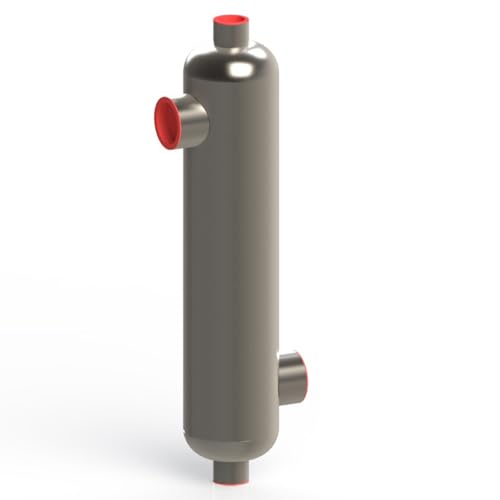
Capacity and design: The SP 2.0 Series handles about 300,000 BTU and includes mounting brackets for installation flexibility. Titanium construction ensures corrosion resistance and durability in saltwater or chemically treated pools and spas. This model is positioned for mid-to-large installations requiring significant heat transfer capacity.
Key benefits: The included mounting brackets simplify positioning and alignment during installation. Titanium’s corrosion resistance helps sustain performance even in harsh pool environments, reducing downtime for maintenance.
Buying Guide: Titanium Pool Heat Exchangers
- Material and corrosion resistance: Titanium offers superior longevity in saltwater and chemically treated pools. Compare alloy purity, welding methods, and corrosion resistance ratings to ensure long-term reliability.
- Capacity and sizing: Match heat transfer capacity (kBtu/hr) to your pool volume and desired water temperature rise. Oversizing can waste energy; undersizing reduces performance.
- Port configurations: Check port sizes (FPT) and arrangement (same-side vs. opposite) to match existing plumbing. Common options include 1″–2″ FPT for water, with corresponding hot-water connections.
- Installation and mounting: Some models include brackets or require custom mounting. Consider space constraints, accessibility for maintenance, and vibration isolation.
- Maintenance considerations: Titanium resists corrosion, reducing maintenance needs. Still, plan for regular inspections, bracket integrity, and cleaning to prevent mineral buildup.
- Warranty and support: Higher-capacity models may offer longer warranties. Verify coverage terms for manufacturing defects and corrosion-related claims.
- Compatibility with systems: Ensure compatibility with your heat source (gas, electric, solar) and with spa or pool features like solar preheaters or engine cooling if applicable.
- Cost and lifecycle: Titanium units typically cost more upfront but can lower lifetime maintenance costs. Evaluate total cost of ownership over the system’s expected life.
- Environmental conditions: For outdoor installations, consider UV exposure, temperature swings, and salt spray—choose enclosures or protective pathways if needed.