Keeping pool water balanced is essential for safe, comfortable swimming. This guide focuses on reliable tools to test salt levels in your pool, whether you’re using a saltwater chlorinator or maintaining a traditional chlorine system. Below are five top options, spanning digital meters and test strips, to help you monitor salinity, pH, and related water quality metrics with precision and ease.
| Product | Brand | Key Feature |
|---|---|---|
| Pool Salt Tester & PH Meter, Hofun 5-in-1 | Hofun | Digital Salinity, pH, temp, EC, TDS with 0-9999ppm range |
| NewTest Pool Salt Test Strips 150CT 8 in 1 | NewTest | 8-in-1 strips for salt, pH, free chlorine, hardness, alkalinity |
| dzdarren 4-in-1 Salt Tester | dzdarren | Salinity, TDS, EC, temperature |
| YUZIIB 5-in-1 Digital Water Tester | YUZIIB | 5 metrics: salinity, pH, TDS, EC, temperature |
| AquaChek Salt Test Strip Titrators | AquaChek | Salt level testing strips for saltwater pools |
The selections below represent a mix of digital meters and test strips to fit different preferences, budgets, and maintenance routines. Each product section includes a direct, clickable link to its Amazon listing, a visual, and a concise feature-focused summary to help you compare at a glance.
Hofun 5-in-1 Pool Salt Tester & PH Meter
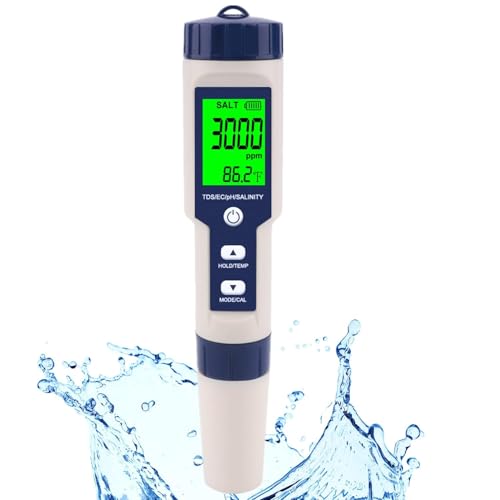
The Hofun digital water tester combines salinity, pH, temperature, EC, and TDS measurements in one handheld device. Designed for swimming pools, aquariums, hot tubs, and hydroponics, it supports multiple unit displays (ppm, ppt, and percent) for straightforward salt readings. Easy operation involves turning the device on and selecting the SALINITY mode for quick results, making it a practical all-in-one tool for maintaining balanced pool water.
NewTest 8-in-1 Pool Salt Test Strips (150 Count)

NewTest provides a comprehensive 8-in-1 strip kit for saltwater pools, hot tubs, and spas. The strips measure Salt, pH, Free Chlorine (Bromine), Hardness, Total Chlorine, Total Alkalinity, and Cyanuric Acid in a single dip. A total of 150 strips supports extended monitoring, and results are designed for quick interpretation to support routine water balance without complex calculations.
dzdarren 4-in-1 Salt Tester

Dzdarren’s 4-in-1 tester focuses on salinity alongside key water quality parameters: Total Dissolved Solids, Electrical Conductivity, and Temperature. This model targets saltwater pool owners seeking a compact, reliable tool to maintain ideal salt levels for salt chlorinators and balanced pool chemistry, with fast, dependable readings.
YUZIIB 5-in-1 Digital Water Tester
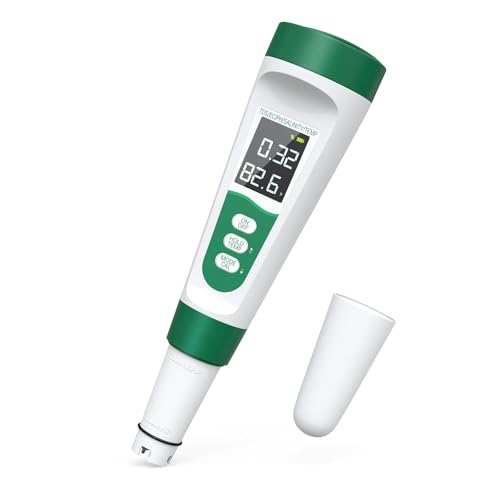
YUZIIB’s 5-in-1 tester covers salinity, pH, Total Dissolved Solids, Electrical Conductivity, and temperature with a high-accuracy single-chip design. Its corrosion-resistant probes and a simple three-second immersion provide rapid readings, making it suitable for frequent testing by pool staff, homeowners, and hobbyists who monitor wellness of saltwater systems, aquariums, and spas.
AquaChek Salt Test Strip Titrators
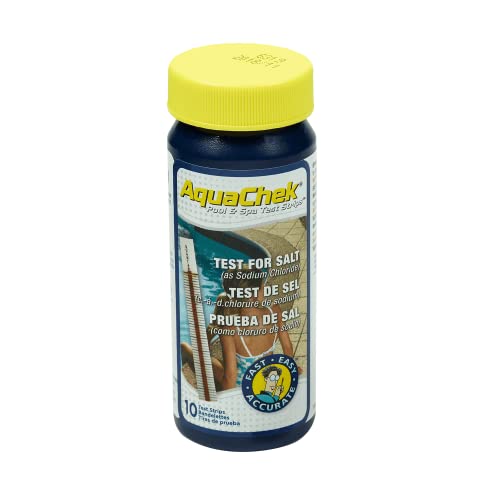
AquaChek Salt Test Strips use white titrators to measure sodium chloride levels in saltwater pools. Designed for accuracy and ease of use, these strips offer a near-laboratory-level approach without reagents, providing quick results that help verify the performance of saltwater generators and ensure water remains within safe ranges.
Buying Guide
Key considerations when choosing a salt level tester for your pool:
- Measurement type: Digital meters provide continuous data for multiple metrics (salinity, pH, TDS, EC, temp), while test strips offer quick, single-occasion checks. Choose based on how often you test and what you need to monitor most.
- Range and units: Ensure the device supports the units you use (ppm, ppt, percentage) and covers the typical salt levels for your pool type (saltwater pools commonly fall in the 1500–4500 ppm range).
- Accuracy and calibration: Look for devices with documented accuracy (e.g., ±1–2% or better) and easy calibration options to maintain reliability over time.
- Ease of use: Consider how quickly results are obtained, whether the device requires frequent maintenance, and how intuitive the display or color charts are for interpretation.
- Durability and suitability: If testing in humid, sunny, or chlorinated environments, choose water-resistant housings and probes designed for saltwater use.
- Maintenance cost: Digital meters may require occasional battery replacements or probe maintenance, while strips incur ongoing consumable costs; balance long-term expenses with your testing cadence.
- Compatibility with other chemistries: If you use a salt chlorine generator, verify the tester aligns with your system’s monitoring needs (e.g., salinity targets, CYA balance).
When selecting a tester, assess your pool’s size, maintenance routine, and whether you prefer all-in-one digital insight or straightforward strip-based checks. Each option above offers distinct advantages for monitoring salt levels and overall water quality, supporting safer, cleaner swimming environments.